Table of contents
Discover what agentic gateways are, how they secure autonomous AI agents with tool-level authorization and session-aware policy enforcement, and why API gateways fall short.
Introduction
Autonomous AI agents are moving from research labs to production workloads. A customer support agent handles tickets across your CRM, ticketing system, and knowledge base. A data analyst agent queries your warehouse, runs SQL transformations, and exports results, all without human intervention. A security operations agent monitors logs, investigates anomalies, and provisions access controls.
These agents do things classical infrastructure was never designed to secure: they make sequential decisions, maintain context across multiple steps, delegate work to other agents, and invoke tools (like APIs, databases, or model context protocol services) based on that context. They operate with permissions that humans never needed, in patterns humans never used.
Traditional API gateways were built for synchronous request-response traffic. Modern AI gateways add token caching and streaming support for LLM workloads. But neither addresses the core problem: How do you authorize an autonomous agent to call a tool?
An agentic gateway is a new category of infrastructure that answers that question. It sits in the network path between AI agents and the resources they access, enforcing identity, policy, and audit controls at the tool level while maintaining the session context and delegation chains that make agents useful.
This article defines agentic gateways, explains their architecture, contrasts them with API gateways and AI gateways, and explores why the industry is converging on this new category—especially after recent moves from Microsoft, the Cloud Security Alliance, and the open-source community.
What Is an Agentic Gateway?
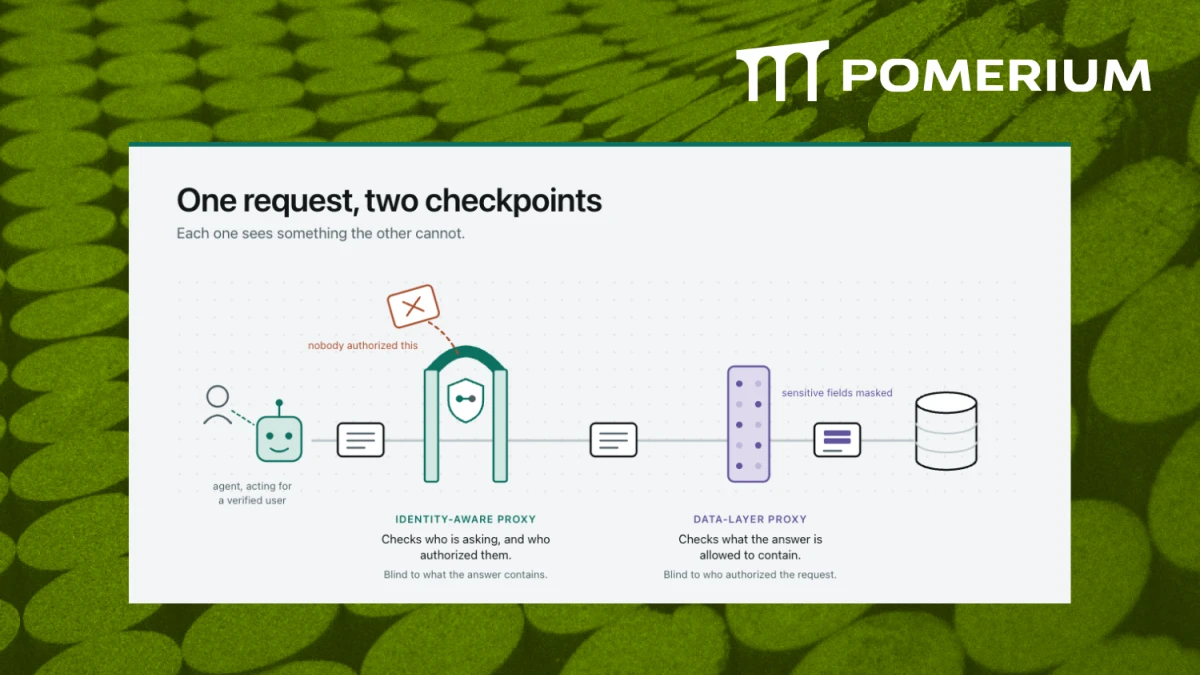
An agentic gateway is a proxy that sits in the network path between AI agents and their downstream resources—APIs, databases, tool services, or Model Context Protocol endpoints—and enforces identity-aware, context-aware, and tool-level authorization policies.
Unlike traditional gateways that treat every request as independent, agentic gateways understand that:
- Agents maintain state across multiple tool calls. A single business process (booking a flight, filing an expense report, investigating a security incident) may involve 5-15 tool invocations with interdependent logic.
- Tool calls carry semantic meaning. A request to "delete all customer records" is not the same as a request to "archive records for the current customer," even if they hit the same API endpoint.
- Agents can delegate authority. When Agent A invokes Agent B, the authorization context must flow through the delegation chain. Downstream services need to know whether the original authority came from a human, a trusted system, or an untrusted third-party agent.
- Session context matters. A policy that says "you can read your own customer record" depends on knowing which customer the agent is working with in this conversation, not globally.
An agentic gateway enforces policies at the tool level, not just at the server or API level. It can say: "This agent can call the create_order tool when invoked by humans, but cannot call the refund tool without multi-party approval." It tracks who authorized what, when, and why—creating cryptographic evidence of agency in a world where agency is increasingly blurred.
Core Capabilities
Identity and Authentication
An agentic gateway authenticates the agent (and often the human operator who launched it) using OAuth 2.1, mutual TLS, or other modern identity protocols. It does not simply pass credentials downstream. Instead, it mints short-lived identity assertions (like signed JWT tokens or SAML assertions) that encode the agent's identity and the context under which it's operating.
Tool-Level Authorization
Where API gateways check "Can this client call this API?", agentic gateways ask "Can this agent invoke this specific tool, in this context, with these parameters?" They enforce fine-grained policy rules that reference the agent's identity, the operation being requested, the resources being accessed, and the session state.
Session-Aware Policy Enforcement
An agentic gateway maintains awareness of the agent's current session—which human it's serving, which previous steps it has executed, what data it has processed, and what delegation chains brought it here. Policies can reference this context. "You can only call the send_email tool if a human has reviewed the message content in this session" is a policy that requires session awareness.
Zero Trust Architecture
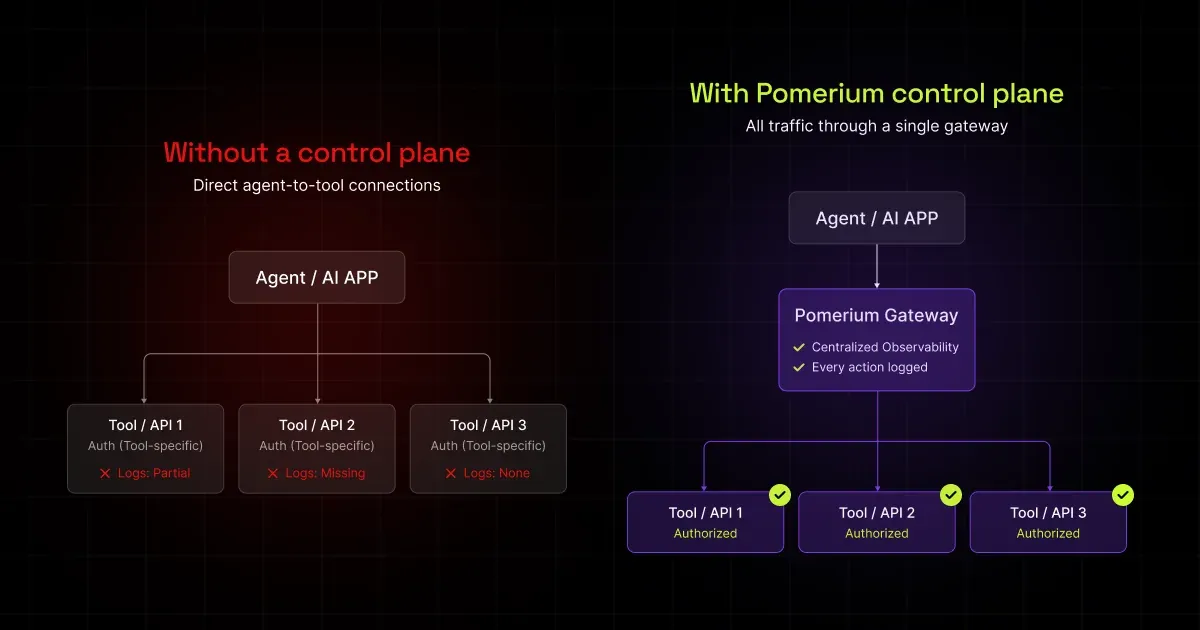
Every request is verified, every identity assertion is cryptographically signed, and every policy decision is logged. The gateway assumes that networks are untrusted—it does not rely on the agent running inside a corporate VPN or a Kubernetes cluster to be trustworthy.
Audit and Compliance
The gateway logs every tool invocation, including who requested it, when, what parameters were passed, what the response was, and whether it was authorized. This creates a tamper-proof record of agent actions—essential for SOC 2, FedRAMP, and other compliance frameworks.
How Agentic Gateways Differ from API Gateways
API gateways have been the standard for 15+ years. They excel at managing HTTP traffic, enforcing authentication, rate limiting, and routing. But they were built for a different era.
The API Gateway Problem
An API gateway treats every HTTP request as an independent transaction. Request 1 and Request 5 are peers; there's no concept of a "conversation" or "session flow". The gateway can check "Does this client have a valid API key?" and route accordingly. It cannot reason about context like "Is this the third request in a sequence that should be rejected?" or "Did a human review this before the agent was allowed to proceed?"
API gateways are built for synchronous request-response patterns. A client sends a request, the gateway applies policies, the request goes to the backend, and a response comes back. Done. But agents don't work this way. An agent may make 10 tool calls, inspect the results, decide the first tool call was insufficient, and retry with different parameters. The "flow" of the conversation matters, not just the individual requests.
Additionally, API gateways operate at the API or endpoint level. They know about routes like /api/customers/{id} or /orders/create. They don't know about "tools"—semantic units like create_order, list_orders, or validate_payment. This distinction matters for agents because the same HTTP endpoint might host multiple tools, and authorization policies need to reference specific tools, not endpoints.
Comparison: API Gateway vs. Agentic Gateway
| Feature | API Gateway | Agentic Gateway |
|---|---|---|
| Primary Use Case | Managing HTTP APIs for traditional applications | Controlling AI agents' access to tools and resources |
| Authorization Scope | API endpoint or service level | Individual tool level |
| Context Awareness | Stateless; each request is independent | Stateful; understands session flow and delegation chains |
| Request Pattern | Synchronous request-response | Multi-step agent workflows with dependencies |
| Policy Model | "Who can access this API?" | "Who can invoke this tool, in this context, with these constraints?" |
| Identity Assertion | Passes credentials or API keys downstream | Mints short-lived, context-specific assertions |
| Delegation | Not designed for multi-party authorization flows | Tracks and validates delegation chains |
| Audit Trail | Request logs | Tool invocation logs + full session context |
| Examples | Kong, Gravitee, AWS API Gateway | Pomerium, AgentGateway |
Agentic Gateways vs. AI Gateways
Over the past year, vendors have introduced "AI gateways"—proxies that add LLM-specific features like token counting, prompt caching, fallback models, and usage tracking. Companies like Gravitee, Solo.io, and Kong have extended their API gateways with these capabilities.
But "AI gateway" and "agentic gateway" are solving different problems.
AI Gateways
An AI gateway sits between an application (or an agent) and LLM API endpoints like OpenAI, Claude, or Anthropic. It optimizes the cost and performance of LLM calls by:
- Caching tokens to reduce redundant API calls
- Splitting requests across multiple model providers for cost optimization
- Rate limiting and quota management per model
- Logging and observability for LLM usage
An AI gateway is model-centric. It focuses on "How do we efficiently call LLMs?" It does not focus on what the agent does after the LLM responds—specifically, which tools the agent can invoke based on that response.
Agentic Gateways
An agentic gateway sits between an agent and its tools and downstream resources. It enforces authorization policies on the tools the agent invokes. It is resource-centric and agent-centric. It focuses on "How do we safely let this agent invoke this tool, given what we know about it and its context?"
Conceptual Difference
Think of it this way:
- An AI gateway optimizes the conversation between an agent and an LLM.
- An agentic gateway controls what an agent can do with the LLM's response.
A production agent deployment typically includes both. The agent calls the LLM through an AI gateway (for cost and performance optimization), the LLM suggests a tool call, and the agent then sends that tool call through an agentic gateway (for authorization and audit).
Comparison: AI Gateway vs. Agentic Gateway
| Feature | AI Gateway | Agentic Gateway |
|---|---|---|
| Primary User | LLM API consumer | AI agent |
| Focus | LLM call optimization and cost management | Tool invocation authorization and audit |
| Sits Between | Application/Agent ↔ LLM | Agent ↔ Tools/Resources |
| Key Policies | Token caching, rate limits, model fallback | Tool-level access control, delegation rules, context constraints |
| Session Context | Stateless model calls | Full agent session state and workflow history |
| Authorization Model | Per-model rate limits and quotas | Fine-grained, context-aware tool access policies |
| Audit Output | LLM usage metrics | Agent action log with intent and authorization chain |
| Example | Gravitee AI Gateway, Solo Gloo AI | Pomerium, AgentGateway |
The Request Lifecycle Through an Agentic Gateway
To understand how agentic gateways work in practice, let's trace a request through the system.
Scenario: An Expense Report Agent
Imagine an autonomous agent that processes employee expense reports. An employee uploads a receipt and asks the agent to submit an expense report. The agent needs to:
- Validate the receipt (OCR on an image)
- Look up the employee's cost center
- Create an expense report in the accounting system
- Send a notification to the manager
Each of these is a separate tool call.
Step 1: Agent Authentication and Session Initiation
The agent (launched by the employee) sends a request to the agentic gateway:
POST /agents/expense-report/invoke
Authorization: Bearer <employee-signed-assertion>
Body: {
  "agent_id": "expense-report-v1",
  "human_operator": "alice@company.com",
  "request": "Process this receipt"
}
The agentic gateway validates the authorization token. It confirms that Alice is a valid employee and that the expense-report-v1 agent is allowed to run on her behalf. The gateway creates a session context that includes:
- Alice's identity and attributes (department, cost center, manager)
- The agent's permissions and constraints
- A session ID for tracking all downstream requests
- A timestamp and audit context
Step 2: Agent Invokes Tool 1 – OCR on Receipt
The agent calls the receipt OCR service. Instead of calling the service directly, the agent sends the request to the agentic gateway:
POST /tools/ocr/invoke
Authorization: Bearer <session-token>
Body: {
  "tool": "receipt_ocr",
  "image_data": "<base64-encoded image>",
  "session_id": "<session-id-from-step-1>"
}
The agentic gateway:
- Authenticates the session token (signed by the gateway, short-lived, 15 minutes)
- Checks policy: "Can the
expense-report-v1agent invoke thereceipt_ocrtool on behalf of Alice?" - Evaluates context: "Is Alice in an approved cost center? Is OCR only allowed once per session?" (yes, yes)
- Mints a downstream credential: Creates a short-lived JWT that asserts "Alice, via the expense-report agent, is invoking the OCR service" and signs it
- Forwards the request to the OCR service, attaching the signed assertion
- Logs the action: Records tool=
receipt_ocr, actor=expense-report-v1, operator=alice@company.com, session_id, timestamp, response
The OCR service returns the extracted text. The gateway passes it back to the agent and logs the request and result.
Step 3: Agent Invokes Tool 2 – Look Up Employee
The agent now needs to confirm Alice's cost center. It calls:
POST /tools/employee-lookup/invoke
Authorization: Bearer <session-token>
Body: {
  "tool": "get_employee_cost_center",
  "employee_id": "alice@company.com",
  "session_id": "<session-id>"
}
The agentic gateway repeats the process: authenticate, authorize, mint downstream credentials, forward, log.
But here's where context matters. The gateway's policy says: "An agent can only look up the cost center of the human operator on whose behalf it's running." Alice is running the agent, so looking up Alice's cost center is allowed. If the agent tried to look up Bob's cost center (a different employee), the gateway would reject it with a policy violation.
Step 4: Agent Invokes Tool 3 – Create Expense Report
The agent now calls the accounting system to create the expense report:
POST /tools/accounting-api/invoke
Authorization: Bearer <session-token>
Body: {
  "tool": "create_expense_report",
  "employee_id": "alice@company.com",
  "amount": 127.50,
  "cost_center": "eng-team-001",
  "receipt_text": "<extracted from step 2>",
  "session_id": "<session-id>"
}
The agentic gateway checks policy: "Can the expense-report-v1 agent create expense reports on behalf of Alice?" Yes. "Is the amount within Alice's delegation limits?" (Assume Alice's company allows employees to file expense reports up to $500 without manager approval.) Yes. "Have we already called this tool in this session?" (Policy: only once per session to prevent duplicates.) No.
The request is forwarded with a downstream assertion. The expense report is created.
Step 5: Agent Invokes Tool 4 – Notify Manager
Finally, the agent sends a notification to Alice's manager:
POST /tools/notification-api/invoke
Authorization: Bearer <session-token>
Body: {
  "tool": "send_notification",
  "recipient": "bob@company.com",  // Alice's manager
  "message": "Alice submitted an expense report..."
}
The agentic gateway checks policy: "Can the agent send notifications?" Yes. "Can it notify the manager?" The policy says: "Only notify the employee's manager, not arbitrary users." The gateway looks at Alice's manager attribute (from step 1) and confirms Bob is Alice's manager. The request is allowed.
The Full Picture
At the end of the session, the agentic gateway has a complete, cryptographically signed log:
Session: sess_abc123
Operator: alice@company.com
Agent: expense-report-v1
Duration: 8 seconds
Tools Invoked:
  1. receipt_ocr (ALLOWED) - 2.1s
  2. get_employee_cost_center (ALLOWED) - 0.3s
  3. create_expense_report (ALLOWED) - 3.2s
  4. send_notification (ALLOWED) - 2.1s
Policies Evaluated: 12
Policies Enforced: 4
Audit Trail: [digitally signed]
This log answers key questions:
- Who authorized this action? (Alice, via her identity assertion)
- What did the agent do? (Created an expense report)
- Did it follow policy? (Yes, every step was authorized)
- If something went wrong, how do we prove it? (Cryptographic signatures)
This is what an agentic gateway provides that an API gateway cannot.
Why Existing Gateways Fall Short for Agents
API Gateways
API gateways excel at authentication and routing, but they have fundamental limitations for agent workloads:
- No session context: They don't track the conversation between the agent and multiple tools. A policy like "you can only delete records if you've first read and validated them in this session" is impossible to enforce.
- No tool-level authorization: They work at the API endpoint level. If an API hosts multiple tools (e.g.,
/api/resources/{action}), the gateway can only grant or deny access to the entire endpoint, not to individual tools. - No delegation chain tracking: When Agent A invokes Agent B, API gateways don't track the authorization flow. They don't know that the original authority came from a human, or that Agent B is a third-party untrusted service.
- No semantic understanding: They don't understand what a tool does. A policy that says "this agent cannot delete data" requires the gateway to understand which operations are destructive—not just which endpoints are called.
AI Gateways
AI gateways focus on the agent-to-LLM path, not the agent-to-tool path. They don't address authorization for tool invocations at all.
Lightweight Agent-Specific Tools
Some projects (like the open-source agentgateway.dev) are building agent-specific infrastructure. But many are early-stage and focus on interoperability (supporting MCP, A2A protocols, etc.) rather than the full security model—identity, policy, audit, and session management—that production deployments require.
The Architectural Advantages of an Agentic Gateway
1. Decoupling Agent from Tool Permissions
Without an agentic gateway, the agent itself carries the burden of checking permissions. If the agent is compromised or misconfigured, there's nothing between it and the tools. With an agentic gateway, permission checks are offloaded to a trusted proxy that the agent cannot tamper with.
2. Multi-Tenancy and Context Isolation
If you're running agents for thousands of users, an agentic gateway provides a central point for enforcing context isolation. A policy can say: "This agent can only access data for the user who launched it." The gateway ensures this, regardless of any mistakes or bypasses in the agent logic itself.
3. Gradual Delegation and Approval Workflows
Some workflows require human approval. An agentic gateway can enforce policies like: "Agents can propose spending up to $1000, but proposals above $5000 require a manager review in this session before proceeding." This requires session-aware policy evaluation, which only an agentic gateway can provide.
4. Audit and Compliance
Regulators don't trust agents yet. They trust logs. An agentic gateway produces audit logs that prove what happened, who authorized it, and whether policies were followed. This is non-negotiable for SOC 2, FedRAMP, HIPAA, and PCI-DSS compliance.
5. Zero Trust for AI
Traditional zero trust (Google's BeyondCorp, Microsoft's Zero Trust for Devices) assumes users and devices are untrusted. Zero trust for AI extends this to agents. An agentic gateway enforces zero trust principles: verify every request, grant least privilege, maintain audit trails, and assume nothing inside the network is trusted.
Key Capabilities You Need in an Agentic Gateway
1. Native MCP Support
The Model Context Protocol (MCP) is becoming the standard for agent-tool communication. An agentic gateway should natively proxy MCP, treating each MCP function as a tool subject to authorization policies.
2. OAuth 2.1 and Modern Identity Protocols
The gateway should handle OAuth 2.1 flows for human operators and support mutual TLS for agent-to-agent communication. It should mint short-lived assertions that encode the agent's identity and context.
3. Fine-Grained Policy Language
You need a policy language that can express complex authorization rules. "The send_email tool is allowed if invoked by a human in this session, but not allowed if invoked by a delegated agent" is a rule your policy language must support.
4. Session State Management
The gateway should maintain rich session context and expose it to policy evaluation. Policies should be able to reference "which tools have been invoked in this session," "who the operator is," "what resources have been accessed," etc.
5. Comprehensive Audit Logging
Every tool invocation should be logged with: timestamp, actor (agent + operator), tool, parameters, response status, policy decisions, and cryptographic signatures. This log must be tamper-proof.
6. Delegation Chain Tracking
When Agent A invokes Agent B, the gateway should track the full authorization chain and pass it downstream. Policies can then reference "was this invoked by a first-party agent or a third-party agent?"
The Emerging Category and Recent Momentum
The agentic gateway category is new, but momentum is building.
Industry Recognition
Microsoft recently announced "Zero Trust for AI" and "Agent 365" at RSA Conference 2026, emphasizing that autonomous agents require new security infrastructure.
The Cloud Security Alliance published an "Agentic Trust Framework" for zero trust governance of AI agents, putting formal guidance behind the category.
Open-source projects like agentgateway.dev are building early implementations with MCP and A2A protocol support, though production-grade policy and audit capabilities are still developing.
Vendors like Kong, Gravitee, and Solo.io have extended their API gateways with AI-specific features, but they're still treating gateways as API proxies, not agent proxies. This is a gap that agentic gateways fill.
Why Now?
Agents are moving from research to production. Companies are shipping customer support agents, data analyst agents, security operations agents. These agents need to access real resources (databases, APIs, file systems, communication systems). The industry is realizing that letting agents access these resources without fine-grained authorization, session context, and audit trails is a risk that compliance frameworks won't tolerate.
Getting Started with Agentic Gateways
If your organization is deploying autonomous agents, here's what to evaluate:
1. Do You Need Agents to Access Multiple Tools or Services?
If your agents only call one or two APIs, you may not need an agentic gateway yet. But if agents are accessing multiple services and making sequential decisions based on tool responses, gateway-level authorization becomes important.
2. Do You Need to Audit Agent Actions for Compliance?
SOC 2, FedRAMP, and other frameworks require audit trails. An agentic gateway provides cryptographically signed logs that prove what happened. If compliance is a requirement, this is essential.
3. Do You Need Context-Aware Authorization?
If your authorization policies depend on session state ("only allow this action if the user has already been validated in this session"), you need an agentic gateway.
4. Are You Running Multi-Tenant Agents?
If you're running agents for many users or customers, an agentic gateway centralizes context isolation and enforcement.
Pomerium as an Agentic Gateway
Pomerium is an open-source agentic gateway purpose-built for securing autonomous agents. It natively supports the Model Context Protocol, enforces tool-level authorization policies, maintains session-aware context, and produces comprehensive audit logs suitable for compliance.
Pomerium runs as a proxy in your network, intercepting tool calls from agents and applying policy. It handles OAuth 2.1 flows, mints short-lived identity assertions, supports zero trust architecture, and provides the session context and audit trail that production agent deployments require.
If you're building or deploying agents, Pomerium gives you a central, trusted point for enforcing security policies—without reimplementing authorization logic in every agent or downstream service.
The Future of Agentic Gateways
As agent deployments scale, we'll see this category mature. Future agentic gateways will likely include:
- Behavioral anomaly detection: Flagging unusual patterns in agent behavior ("this agent has never called this tool before, and the policy hasn't changed—is it compromised?")
- Cross-agent authorization: When Agent A delegates to Agent B, enforcing policies about what authority can be transferred and what must be retained
- Real-time policy updates: Policies that change based on threat intel, compliance requirements, or business changes
- Agent-to-agent trust frameworks: Standardized ways for agents to assert their trustworthiness to other agents
- Integration with enterprise identity systems: Seamless integration with Okta, Azure AD, and other enterprise directories
The category is nascent, but the need is clear. As agents move into mission-critical workflows, governance and audit will be table stakes.
Conclusion
An agentic gateway is infrastructure for a new era: one where autonomous AI agents make real decisions and invoke real resources.
Unlike API gateways, which treat every request as independent, agentic gateways understand that agents maintain context across multiple steps, delegate authority, and operate in patterns humans never did. They enforce tool-level authorization, not just endpoint-level access control. They track delegation chains, maintain session state, and produce audit logs that prove what happened and whether policies were followed.
This is not an incremental improvement on API gateways. It's a new category, solving new problems, for a new workload.
If you're shipping agents into production, you're already thinking about security, compliance, and audit. An agentic gateway is the infrastructure that makes those concerns operationalized.
Next Steps: Explore Pomerium
If your organization is deploying autonomous agents and needs to govern tool access, audit actions, and enforce zero trust policies, Pomerium provides an open-source agentic gateway with:
- Native MCP support for Model Context Protocol tools
- Tool-level authorization policies that understand agent context
- Session-aware enforcement that tracks multi-step workflows
- Zero trust architecture with cryptographic identity assertions
- Comprehensive audit logging for compliance and forensics
- Open-source so you can inspect, modify, and self-host
Learn more at Pomerium.com or explore the source code on GitHub. For a technical deep dive, see our documentation on agentic gateway architecture and policy evaluation.
The era of ungoverned agents is ending. The era of agent governance is beginning. Make sure you're ready.